Suction power tells you how strongly a robot vacuum pulls dust, dirt, crumbs, and pet hair from your floor into its dustbin. Stronger suction can improve cleaning, but it’s only one part of the story. The best robot vacuum combines good suction with smart navigation, efficient brushes, and reliable battery life.
The answer is simpler than you might think.
What Is the Suction Power of a Robot Vacuum?
When you compare robot vacuum cleaners online, you’ll often see numbers like 2,500Pa, 5,000Pa, 8,000Pa, or even 20,000Pa. At first, these numbers can be confusing. Does a higher number always mean better cleaning? Should you buy the robot vacuum with the highest suction power?
Table of Contents
Let’s break it down in simple words.
What Does Pa Mean?
Suction power is measured in Pascals (Pa), which is a unit of pressure. In robot vacuums, the Pa rating shows how much pulling force the motor can create.
Think of it like using a straw. A gentle sip picks up only a little liquid, while a stronger sip pulls up much more. A robot vacuum works similarly. Higher suction creates stronger airflow, making it easier to lift dust, pet hair, and dirt from the floor.
However, bigger numbers don’t always guarantee better cleaning.
Why Does Suction Power Matter?
Imagine dropping biscuit crumbs on your kitchen floor or noticing pet hair collecting under your sofa. A robot vacuum with enough suction can quickly remove these messes without leaving anything behind.
On hard floors, dirt usually sits on the surface, so moderate suction works well. Carpets are different because dust and hair become trapped between the fibers. That’s why carpeted homes need stronger suction for a deeper clean.
Choosing the right suction power helps your robot vacuum clean efficiently without paying for features you may never need.
How Much Suction Power Do You Really Need?
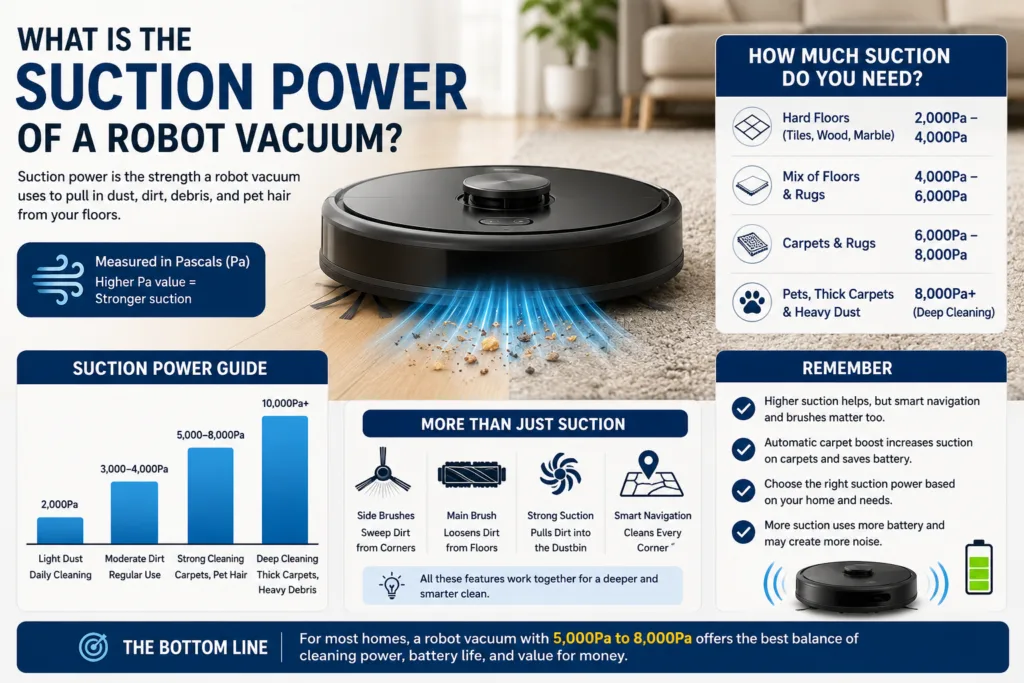
The ideal suction power depends on your home, not the biggest number on the box. If your home has mostly tiles, marble, or wooden flooring, a robot vacuum with around 2,000Pa to 4,000Pa is usually enough for everyday cleaning. It can easily pick up dust, hair, and small debris.
For homes with a mix of hard floors and rugs, 4,000Pa to 6,000Pa offers a better balance. It provides stronger cleaning without using unnecessary battery power. If you have pets, thick carpets, or children who often leave crumbs behind, look for a robot vacuum with 6,000Pa to 10,000Pa. This extra power helps remove dirt hidden deep inside carpet fibers.
Is Higher Suction Always Better?
Not necessarily. Many buyers assume that a 10,000Pa robot vacuum will always outperform a 5,000Pa model. In reality, cleaning performance depends on much more than suction alone.
A well-designed robot vacuum with quality brushes and smart mapping can clean better than another model with a higher Pa rating. Features such as obstacle avoidance, efficient airflow, and intelligent navigation often make a bigger difference in daily use.
Instead of chasing the highest suction rating, look for a robot vacuum with a balanced mix of features.
More Than Just a Powerful Motor
Think of a robot vacuum as a cleaning team, not a single machine. The side brushes sweep dust out of corners. The main brush loosens dirt from the floor. The suction motor pulls everything into the dustbin. Finally, smart navigation ensures it cleans every room without missing areas or wasting time.
Together, these parts keep your floors cleaner with less effort.
What Is Automatic Carpet Boost?
Many modern robot vacuums include a feature called Carpet Boost. As soon as the robot moves from a hard floor onto a carpet, it automatically increases suction. When it returns to tiles or wood flooring, the suction drops back to normal.
This smart feature improves carpet cleaning while saving battery power, giving you the best of both worlds.
Does Stronger Suction Drain the Battery?
Yes, stronger suction uses more energy because the motor has to work harder. That’s why most robot vacuums offer different cleaning modes such as Quiet, Standard, Strong, and Max. You can choose the mode that matches your cleaning needs, or let the robot adjust suction automatically based on the floor type.
This helps extend battery life without sacrificing cleaning performance.
Which Suction Power Is Best for Your Home?
There isn’t one perfect answer because every home is different. For apartments with mostly hard floors, 2,000Pa to 4,000Pa is usually enough for daily cleaning.
For most families, 5,000Pa to 8,000Pa is the sweet spot. It handles dust, hair, crumbs, and light carpets with ease while offering excellent value for money. If your home has multiple pets, thick carpets, or large living spaces, choosing a robot vacuum with 8,000Pa or more will provide stronger deep-cleaning performance.
Also Read: Stop Sweeping Every Day: Best Robot Vacuums for Indian Homes
Don’t Judge a Robot Vacuum by Suction Alone
When comparing robot vacuums, don’t focus only on the Pa rating. Also consider the navigation system, battery life, brush quality, obstacle detection, app features, and mopping performance. These features often matter more for everyday cleaning than suction power alone.
Reading customer reviews can also give you a better idea of how a robot vacuum performs in real homes.
Final Thoughts
Suction power is one of the most important features to consider when buying a robot vacuum, but it shouldn’t be the only factor in your decision. A higher Pa rating helps lift more dust and dirt, especially from carpets, but smart navigation, quality brushes, and efficient battery management are just as important.
For most homes, a robot vacuum with 5,000Pa to 8,000Pa provides the perfect balance of cleaning performance, battery life, and price. Instead of simply choosing the highest number, choose the robot vacuum that fits your flooring, lifestyle, and cleaning needs. That’s the smartest way to keep your home clean every day.
Frequently Asked Questions
Is 2,000Pa enough for a robot vacuum?
Yes. It’s suitable for apartments and homes with hard floors where daily cleaning is the main goal. It may struggle with thick carpets and heavy pet hair.
Is 5,000Pa good for a robot vacuum?
Yes. A 5,000Pa robot vacuum is an excellent choice for most homes. It cleans well on tiles, wood floors, rugs, and light carpets.
Is 10,000Pa suction too powerful?
Not at all. If you have pets, thick carpets, or a larger home, a 10,000Pa robot vacuum can deliver deeper and more effective cleaning.
Does higher suction make a robot vacuum louder?
Generally, yes. Higher suction settings create more noise, although many premium robot vacuums are designed to remain relatively quiet even at maximum power.
Does suction power affect mopping?
No. Suction power only affects vacuuming. Mopping performance depends on the water flow, mop pads, and scrubbing system built into the robot vacuum.